All posts by admin_medicinemanufacturer

third party pharma manufacturing products

What Products Can Be Manufactured Through Third Party Pharma Manufacturing?

Third party pharma manufacturing can be a viable business model for pharmaceutical companies, startups, distributors, marketing companies, etc. who would like to introduce medicines without setting up their manufacturing plants. Based on this, in the manufacturing model, the company concerned with the marketing process also assumes responsibility for packaging, quality exam and manufacturing the product while third party pharma manufacturing company handles the entire manufacturing process.

Many of its benefits include the wide range of third party pharma manufacturing products categories. Depending on the manufacturer’s expertise, and regulatory needs, manufacturing can be done on a variety of products, including tablets, capsules, syrup, injection products, topical preparations, nutraceuticals, and specialized formulations.

What are the various kinds of third party pharma manufacturing products that can be made ?

1. Tablets

Tablets are some of the most popular dosage forms made. These may be general medications, anti-bacterials, pain relievers, anti-inflammatories, heart and blood sugar pills, and multi-vitamin pills.

2. Capsules

Hard and soft capped can be additionally produced through third-party pharmaceutical manufacturing. These can encompass standard pharmaceutical formulations, nutritional products, antibiotics, and special therapeutic products.

3. Syrups and Dry Syrups

Liquid formulations applied in Pediatric, General Medicine, Respiratory, Nutritional and other segments are making high usage. The syrups, suspensions and dry syrups may be manufactured by third party manufacture based on the given formulation and packaging specifications.

4. Injections

Specific manufacturing facilities and quality controls are needed for injectable formulations. Third party pharma manufacturing in India may be a liquid injection, dry injection, or other preparations available for injection, depending upon the capability of the manufacturer.

5. Ointments, Creams and Gels

Pharmaceutical products which you can apply to the skin include medicines for dermatology and pain relief, anti-fungal medications and more. For companies introducing their own product lines these products can be custom packaged and brandished to launch the brand.

6. Ophthalmic and Nasal Products

There are also eye drops, ophthalmic preparations and nasal sprays made by some specialty manufacturers. Due to the method of administration of these products, they need to be processed with specific manufacturing and quality control procedures.

7. Nutraceutics & Health Supplements

Conventional medicines aren’t the only medicines subject to third party pharmaceutical manufacturing. Additionally, businesses can consider nutraceutical products (among others) including multivitamins, minerals, protein powders, probiotics, omega-3 products & others, where applicable.

8. Products used in Ayurveda and Herbal medicine.

Depending on the manufacturing capability, prescriptions of cost-effective Ayurvedic and herbal medicines like syrups powder, oil, balms and proprietary herbal medicines can also be included as per the manufacturer’s ability.

9. Specialized Therapeutic Segments

Third party manufacturing may be expanded to areas of therapeutic interest like:

• Medicines for the heart and diabetes
• Orthopedic- and bone health-related products
• Gynaecology products
• Pediatric medicines
• Medications for neurology and psychiatry.
• Gastrointestinal medicines
• Respiratory products
• Dermatology formulations
• Critical-care products

Specific product availabilities will vary depending on manufacturer facilities, approvals, formulation abilities and regulatory needs.

Benefits of Third Party Pharma Manufacturing in India

  • A diversified pharma products manufacturing base enables pharma companies to search for trendy products and create multiple products without allocating their very own manufacturing facilities. Manufacturing partner can focus on production related tasks and the company can focus on branding and marketing, distribution and market expansion.
  • Third party manufacturing can also offer access to formulation support, private-label options and scalable production as well as customized packaging.
  • But before choosing a partner, companies need to consider the quality of the products/services, the documentation provided, the manufacturing capabilities, minimum order quantities, the price, and the schedule for delivery.

What are the reasons to think about using PV molecules As third party pharma manufacturing company?

  • Portal to enable businesses to connect with pharmaceutical manufacturers and partners in various segments such as Allopathic, Ayurvedic, Herbal, nutraceutical, Veterinary, Cosmetic products etc. It details its third party/manufacturing services, product development, procurement manufacturing, packaging and documentation support in compliance with regulations on its electronic platform.
  • The site offers wide range of products including tablets, capsules, syrups, dry syrups, injections, ointments, ophthalmological preparations, nutraceuticals, hormonal preparations, cardiac and diabetic ranges and more.
  • PV Molecules also shines a light on private-label manufacturing, customized packaging, and assistance for start-ups and emerging pharma firms seeking to create a branded pharmaceutical portfolio.

Conclusion

Third party pharma manufacturing services can be applied to a diverse range of third party pharma manufacturing products, such as tablets, capsules, syrups and dry syrups, injections, ophthalmic preparations, ointments, creams, gels, nutraceuticals, specialized therapeutic formulations, and herbal products. This indicates the best performance parameters that the manufacturer can achieve, which may differ due to regulatory approvals, manufacturing capacity, etc.

Selecting the right manufacturing partner that has a proper product portfolio, quality systems, customization capability and reliable support would be the key considerations for those businesses that want to start or expand a pharma brand. PV Molecules could be a platform to consider for third party and private-label needs for a range of pharmaceutical categories, and help match customers with manufacturing options.

Frequently Asked Questions

Q1.  Is it possible to create customized pharma products which is supplied by third party manufacturers?

Ans: Yes, there are plenty of manufacturers out there who provide customized formulations and packaging along with labelling and can develop a private label option to suit the requirements of the business and the applicable regulations.

Q2. Why use PV Molecules for 3rd party pharma manufacturing?

Ans: PV Molecules offers solutions for manufacturing in the pharmaceutical industry in a number of categories and identifies solution integration for product development, procurement, packaging, private-label needs, and regulatory documentation.

Q3. What products can be manufactured through third party pharma manufacturing?

Ans: Third party pharma manufacturing includes tablets, capsules, syrups, dry syrups, injections, ointments, creams, gels, ophthalmic products, nutraceuticals, herbal medicines, and specialized therapeutic formulations.

Q4. Can third party manufacturers provide customized pharma products?

Ans: Yes, third party manufacturers can offer customized formulations, private-label manufacturing, packaging, and labelling services according to product requirements and applicable regulations.

Q5. Why choose PV Molecules for third party pharma manufacturing?

Ans: PV Molecules offers third party and private-label manufacturing solutions for tablets, capsules, syrups, injections, nutraceuticals, and other pharmaceutical products, along with customized packaging and documentation support.
Pharma Manufacturing Company in India

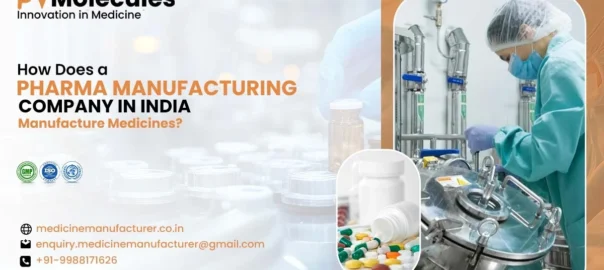
How Does a Pharma Manufacturing Company in India Manufacture Medicines?

Ever wonder what actually happens before a tablet reaches your medicine cabinet? Manufacturing medicines is more than just mixing powder and pressing it into a pill.

Before a single strip of medicine reaches a pharmacy shelf, a pharma manufacturing company goes through a long, tightly controlled process, with checks at every stage.

India is a major producer of medicines for the world. In fact, it is known as the “Pharmacy of the World”. But how exactly does a medicine manufacturing company take raw chemicals and turn them into something safe enough to swallow?

Let’s go through the entire journey, step by step.

Pharma Manufacturing Company: An Overview 

At its simplest, a pharma manufacturing company takes an approved drug formula. Then, it turns it into a finished product in the form of tablets, capsules, syrups, injections or ointments. All these finished products must meet strict safety and quality rules.

It’s not a one-person job. It involves collaboration between chemists, quality analysts, machine operators and regulatory experts. Each batch is processed with documented steps. Also, it is checked and signed off prior to the next batch.

The majority of pharmaceutical manufacturing companies in India operate under WHO-GMP (Good Manufacturing Practice) guidelines. That means the facility, the equipment, and even the air inside the plant meet certain standards.

The Pharmaceutical Manufacturing Process, Step-by-Step 

  1. Development of the Formulation 

The R&D team figures out the formula before any large-scale production starts.

They decide on the right blend of active pharmaceutical ingredient (API) and excipients (the inactive ingredients that bind, coat or stabilise the drug), and the final dosage form.

Formulation is not guesswork. They do stability testing to see how the drug behaves over time. It is tested under different temperatures and in different packaging materials. If a formula degrades or loses potency within six months, it never makes it past this stage.

  1. Raw Material Procurement and Testing 

Once the formula is approved, the company finds APIs and excipients from approved suppliers. Each batch of raw material is tested internally before use. If one parameter is out of spec, that batch is rejected, no exceptions. If a manufacturer cuts corners here, they will see it later when the drug fails stability testing or dissolution testing.

  1. Granulation, Mixing and Compounding 

Powders must be prepared for proper compression into pills or for filling into bottles. The preparation depends on the dosage form:

Tablets and Capsules: Raw powders are granulated (wet or dry) to convert fine particles into uniform granules. This allows the powder to flow through high-speed equipment and compress uniformly.

Syrups and Liquids: Liquid compounding, high-shear mixing and fine filtration of active ingredients and excipients (sweeteners, preservatives and flavourings) are done to achieve uniform solution density and clarity.

  1. Compression, Encapsulation or Coating 

This is where the medicine takes its last physical form.

  • Tablets are pressed on high-speed tablet presses.
  • Encapsulation machines are used to fill capsules with powder, granules or liquid.
  • Syrups and liquids are blended, filtered and bottled.
  • The injections are prepared in sterile, controlled conditions, because even the slightest risk of contamination is unacceptable here.

Each process is done in cleanrooms where air quality, humidity and even staff clothing are controlled.

  1. Quality Assurance & Testing 

Each batch is sampled and tested for weight, hardness, dissolution rate, disintegration time and, most importantly, whether the actual drug content is as indicated on the label. And they do microbial testing as well, particularly on liquids and injectables.

  1. Packaging and Labelling 

Once approved, the product is then packed. The packaging depends on the product. It can be a blister pack, strip, vial or bottle. By law, labels must contain the batch number, the date of manufacture, the expiry date, dosage instructions and storage conditions.

  1. Documentation and Regulatory Clearance 

As the product reaches this stage, all lots have batch records, quality reports, and certificates of compliance. This paperwork is required to be reviewed by regulatory bodies such as the CDSCO (or relevant bodies for export markets) to allow products to be sold.

Stage What Happens
Formulation R&D fixes API + excipient blend, dosage form; stability tested across time & temperature
Raw Material Sourcing APIs/excipients bought from approved suppliers; every batch tested – off-spec gets rejected
Granulation & Mixing Powders granulated for tablets/capsules; liquids compounded & filtered for syrups
Compression / Fill / Coat Tablets pressed, capsules filled, syrups bottled, injections filled in sterile cleanrooms
Quality Testing Checked for weight, hardness, dissolution, disintegration, label-match, microbial safety
Packaging & Labelling Blister/strip/vial/bottle packing; label shows batch no., dates, dosage, storage
Documentation & Approval Batch records & compliance certificates reviewed by CDSCO (or export body) before sale


Choosing the Right Manufacturing Partner 

By this point, you must have understood how medicines are manufactured.

If you are looking for a medicine manufacturer in India, it can be an overwhelming process as you need to check if they are a WHO-GMP certified company.

The other factors to check are pricing, feedback, and delivery timelines. It can take a lot of time as well as enormous effort, especially if you don’t have resources for that process.

This is where PV Molecule can help you. It is a B2B platform. It lists several verified medicine manufacturers and pharma companies. All you need to do is explore to find the one that can meet your needs.

This platform connects brands with verified WHO-GMP-certified pharma manufacturers across India.

Stop cold-calling dozens of factories. Instead, search PV Molecules for a pharma manufacturing company that already matches your product category, whether it’s tablets, capsules, syrups, injections, ointments or nutraceuticals.

PV Molecules also lists third-party and contract manufacturers. If you want to launch your own brand without setting up a plant, you’ll find partners for that too. It is a quick, practical way to get through a jam-packed, confusing market. It makes it easier to avoid the guesswork of vetting a medicine manufacturing company yourself.

Frequently Asked Questions 

Q1. What is the primary function of a pharma manufacturing company? 

Ans: They turn an approved drug formula into a finished product ready for the market. The company also makes sure that it meets all safety, quality and regulatory requirements.

Q2. What is the difference between third-party manufacturing and contract manufacturing? 

Ans: With third-party manufacturing, the brand takes care of marketing and sales, while the manufacturer handles everything else. In contract manufacturing, the brand can control the ingredients to be used in the formulation.

Q3. Why is quality control so important in pharmaceutical manufacturing? 

Ans: Even minor mistakes in dosage or contamination can harm patients. That’s why testing medicines at each stage is non-negotiable.

Q4. Can Indian pharma manufacturing companies be trusted for export? 

Ans: Yes. Indian-manufactured medicines are exported to over 200 countries, many of which have WHO-GMP, ISO and US FDA approvals. In fact, India is called the “Pharmacy of the World”.

Q5. How to find the top medicine manufacturing firm in India?  

Ans: Look for WHO-GMP certification, pricing, feedback, and delivery timelines. If you don’t want to go through that overwhelming process, PV Molecules has a platform listing several verified pharma companies.

Q6. What are the raw materials used for the manufacture of drugs? 

Ans: The key materials are Active Pharmaceutical Ingredients (APIs) and excipients like binders, fillers, preservatives and tablet coatings.

Q7. What if the quality test of a production batch fails? 

Ans: The whole batch is rejected and destroyed safely. No matter how much money is lost, it can never be repackaged and put on the market.


Third-Party Pharma Manufacturing Cost in India

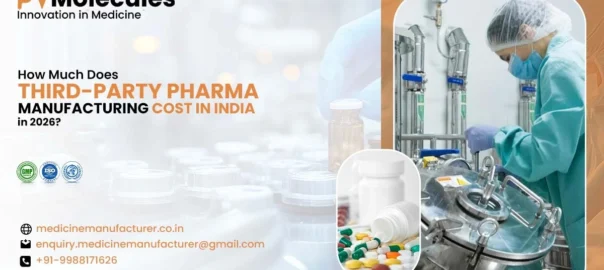
How Much Does Third-Party Pharma Manufacturing Cost in India in 2026?

In India, third-party manufacturing can cost around INR 2 lakh to INR 5 lakh.   

This cost covers wholesale drug licensing, trademark filings, box designs and a starting portfolio of 5 to 10 products. But third-party manufacturing is not a simple “pay and receive” transaction. It requires careful planning.  

Understand the factors determining the  third-party pharma manufacturing cost in India. Above all, you should know what you are actually paying for. It helps you build your budget accordingly. It is not something that you pay and order and get.  

This guide breaks down licensing fees, per-unit production rates, hidden charges, and the tricks that help you keep your medicine manufacturing cost under control in 2026. 

 What is Third-Party Pharma Manufacturing? 

In a third-party manufacturing model, you hire a manufacturer to get your medicine manufactured. Your product is manufactured by a licensed medicine manufacturer as per your specifications. You take care of the branding, marketing and sales side.  

The manufacturer handles the entire manufacturing process. Once you order them, it is their responsibility to source the raw materials, do quality checks and ship to your address.  

This helps keep the cost of pharmaceutical manufacturing in India affordable. 

After all, you’re not paying for machinery, factory staff, or GMP audits yourself. PCD franchise operators and new brand owners favour this route because it lets them launch products fast, without needing crores in upfront capital. 

 What Drives Third-Party Pharma Manufacturing Cost 

Before you look at real figures, it helps to know what factories actually price for.  

 Active Pharmaceutical Ingredients (APIs) 

The API is the part of the medicine that does the work. Higher-purity APIs cost more upfront. But they pass lab assays without trouble and hold their potency for longer on the shelf. 

 Packaging 

Packaging does more than look good on a pharmacy shelf. It keeps moisture, air, and light away from the product inside. 

Standard PVC/aluminium blister packs are the cheapest option. Alu-alu packs cost more per strip, but block humidity far better, which matters for moisture-sensitive drugs. Glass bottles and HDPE jars cost noticeably more than plain PET bottles. 

 Minimum Order Quantity (MOQ) 

Every factory needs setup time to calibrate machines and clean lines between batches. Larger orders spread that setup cost across more units. As a result, your third-party manufacturing price per strip or bottle drops as your order size goes up. 

 Third Party Pharma Manufacturing Cost in India: The 2026 Breakdown 

Generally, third-party manufacturing costs nearly ₹2 lakh to ₹5 lakh for a portfolio of 5 to 10 products. That figure covers your regulatory fees, design work, and first production run. 

Your total third-party pharma manufacturing cost splits into two buckets: one-time setup expenses and variable batch costs that repeat with every order. 

One-Time Setup Expenses: 

 If you are a beginner, there are certain things you need to start your business. The good thing is that these are one-time investments, as you walk through the table given below:  

Expense Typical Cost (INR) What It Covers
Drug Licence & GST Registration ₹15,000 – ₹25,000 Legal authority to buy, store, and sell drugs
Trademark Registration ₹4,500 – ₹6,000 per brand Protects your brand name legally
Packaging & Label Design ₹5,000 – ₹15,000 Artwork for foils, cartons, and labels
Cylinder/Die Charges ₹2,000 – ₹5,000 per product Custom printing plates for foils and boxes

Product-Wise Production Costs

Your actual third-party medicine manufacturing cost depends heavily on which dosage form you pick. Factories set minimum order quantities to keep their manufacturing process cost-effective.

Product Type Typical MOQ Per-Unit Cost Average Batch Cost
Tablets (Blister/Alu-Alu) 30,000–50,000 tablets ₹0.80–₹3.20/strip ₹60,000–₹95,000
Hard Gelatin Capsules 30,000–50,000 units ₹1.10–₹3.50/strip ₹65,000–₹1,10,000
Liquid Syrups (100ml) 5,000 bottles ₹18–₹35/bottle ₹90,000–₹1,75,000
Injectables (Vials) 5,000 units ₹50–₹150+/unit ₹2,50,000+
Protein Powder (1kg Jar) 500–1,000 jars ₹280–₹600/jar ₹1,40,000–₹3,00,000

GST of 12% to 18% applies on top of every one of these production costs. That’s why you should account for that in your final numbers. Add these figures up correctly, and you’ll have a realistic picture of your third-party pharma manufacturing cost before you place your first order.

 How Order Volume Changes Your Third Party Manufacturing Price

Batch size is the single biggest lever you have over cost. Every production process needs machine calibration and ingredient blending. Those fixed costs get divided across however many units you make.

Batch Size Per-Unit Savings Best For
1,000 units Highest cost per unit Testing local demand without heavy inventory
5,000 units 15% – 20% lower Standard balance of risk and efficiency
10,000+ units 25% – 40% lower Established brands with steady regional sales

Ordering bigger batches is the fastest way to bring down your third-party pharma manufacturing cost per unit, provided you’re confident you can sell the stock.

 Hidden Costs to Watch Out For

New brand owners often forget the smaller charges that sit outside the headline quote.

  • Freight tops the list. 
  • Prices are quoted ex-factory, so moving finished stock from hubs like Baddi or Solan to your warehouse gets billed separately. 
  • Batch testing is another one: basic testing comes with your order, but advanced assays or microbiological tests add small fees per batch. 
  • And unsold stock sitting in temperature-controlled storage racks up monthly charges over time. 

 How to Bring Down Your Pharmaceutical Manufacturing Cost in India

You don’t need to spend blindly to launch a brand.

A few practical habits keep your total third-party pharma manufacturing cost in check.

  • Stick to standard pharmacopeial formulations for your first launch. Custom formulas need extra testing and unique tooling, and that’s cost you don’t need for a first product. 
  • Keep packaging sizes uniform across your range too; ordering foil in bulk for three tablet products saves money across every SKU.
  • Where you manufacture matters as well. Clusters like Baddi in Himachal Pradesh and Panchkula in Haryana have deep supplier networks nearby, which keeps freight and raw material costs affordable. 
  • Plan your inventory ahead of time, too. Rush orders strain factory schedules and usually come with a premium surcharge attached.

Let PV Molecules Find You an Affordable Yet Efficient Third-Party Manufacturing Company

Finding a manufacturer who’s transparent about pricing and reliable on delivery timelines makes a real difference to your planning. 

PV Molecules has built a name as one of India’s trusted B2B pharma portals. We connect brand owners with WHO-GMP certified manufacturers across categories like tablets, capsules, syrups, and injectables. Let’s find the one that not only meets your budget, but also offers quality services. 

Frequently Asked Questions

Q1. What is the initial investment to start a third-party pharma business in India?

Ans: Most of the new startups start with a working budget of Rs 2 lakh to Rs 5 lakh. That includes wholesale drug licensing, trademark filings, box designs and a starting portfolio of 5 to 10 products. 

Q2. How much does it cost to produce one batch of tablets?

Ans: For a minimum order of 30,000 to 50,000 tablets, the cost ranges from ₹60,000 to ₹95,000 as a standard. Final pricing is based on the simple blister or Alu-Alu protection you decide. 

Q3. Are third-party manufacturers responsible for product design and labelling?

Ans: Yes, most contract manufacturers can help with artwork and box design. They ensure your labels are compliant with all mandatory regulatory requirements laid down by India’s drug authorities.

Q4. How long does the third party manufacturing process take?

Ans: The first cycle of manufacturing is 30 to 45 days. This time includes the approval of the artwork, testing of raw materials, production and final quality control checks. Repeat orders are usually completed faster, in 20-30 days.

Q5. Will third-party pharma manufacturing be profitable in 2026? 

Ans: Yes, contract manufacturing continues to be a very profitable business. It is associated with very low operational costs, and brand owners can easily find cost-effective WHO-GMP manufacturing facilities. This helps create sustainable brand value and achieve high gross profit margins.

Third-Party Pharma Manufacturing Company in Gujarat

How to Choose the Best Third-Party Pharma Manufacturing Company in Gujarat?

Gujarat makes more medicine than any other state in India. Also, it is a top pharma export hub. If you are looking for a third-party pharma manufacturing company in Gujrat in this state, you can easily find one.  

But that doesn’t mean you Google the company, call them, and sign a deal with them. Not every pharma manufacturing company can meet your needs. Maybe they don’t specialise in manufacturing your products. Maybe you find that they carry an expired license only after placing the order. Maybe they have hidden prices. Even worse, they can be just a trader calling themselves a “manufacturer”. 

A beginner is likely to face such issues unless they know how to choose the right manufacturer.  

Keeping this in mind, we have come up with this simple guide to help you choose the right one. Let’s get started.  

The Pharmaceutical Industry in Gujarat: An Overview 

  • Gujarat is India’s top pharma hub. The state accounts for nearly 40% of India’s drug manufacturing and nearly 28% of drug exports.  
  • Most of the pharma manufacturers are located in cities like Ahmedabad and Vadodara.  
  • The pharma industry in Gujarat is valued at US$5.5 billion. 
  • The state has recently received INR 2,500-3,000 crore in fresh investments. 
  • It houses over 130 USFDA-approved units and over 600 WHO-GMP compliant manufacturing plants. 
  • The state is home to big companies like Sun Pharmaceuticals, Zydus, and Baxter.  

Choosing the Right Third-Party Manufacturer in Gujarat 

1. Start With the Licence, Not the Price List 

Every genuine third-party medicine manufacturing unit in Gujarat should hold a valid state drug licence. Ask for WHO-GMP certification. Check for valid FDCA licences and DCGI approval for the exact products you want made. 

If you are looking to export, make sure to check their USFDA or EU-GMP approval. Fixing this later is slow and costly. Clean paperwork now saves you from surprises later. 

2. Check If They Are Licensed to Make Your Products 

Not every plant handles every dosage form well.  

Check that the licence covers your exact product type. A plant licensed for tablets may not be approved for injectables or eye drops. This sounds obvious, but it trips up new franchise owners all the time. They sign a deal. They place an order. Then they find out the product sits outside the manufacturer’s approval. 

3. Visit the Plant if You Can 

Website photos won’t tell you how a factory really runs. Visit in person if you’re able to. Look at how raw materials are stored. Check basic hygiene on the floor. See how the QC lab is set up. A good Pharmaceutical Manufacturing Company in Gujarat will welcome the visit.  

Can’t visit? Ask for a video walkthrough instead. Most decent manufacturers will allow this.  

4. Check What They Actually Make 

Some firms that call themselves a third-party pharma manufacturing company in Gujarat are really traders. They outsource the work and add a markup. That’s not illegal, but you should know which one you’re dealing with. 

Ask direct questions. Who owns the plant? Is production done in-house? Or is it passed further down the chain? A real manufacturer answers fast. They can usually show batch records for products like yours. 

5. Look at Product Range and MOQ 

A wide product range under one roof saves you from juggling several vendors. Check whether the third-party pharma manufacturing company you’re choosing covers your segment properly. This could be general, cardiac, derma, neuro or gynae. Ask for their full product list up front, so you’re not stuck adding a second manufacturer six months into launch. 

Minimum order quantities vary a lot. Some manufacturers start at 50,000 units per SKU. Others go much lower for new brands still testing the market. Get the MOQ and lead time in writing before you commit. That way you won’t get caught out on your first big order. 

6. Check the Packaging 

Packaging does two jobs: it protects your product, and it helps sell your product. Check whether the manufacturer can handle what you need, from Alu-Alu blisters to strip packs to bottles. Ask about serialisation and anti-counterfeiting features too. This part gets overlooked often, but weak packaging can undo good formulation work fast. 

Also, check if the package design offered can match your brand identity.  

Ask to see sample artwork from your third-party medicine manufacturing in Gujarat unit before you finalise anything. 

7. Check the Documentation 

You’ll need Certificates of Analysis, stability data, and proper batch records for every order. This is even more important if you plan to sell across states. A solid Pharma Contract Manufacturing in Gujarat partner gives you this without being asked twice. 

8. Payment Terms and Reliability 

Talk to other PCD franchise holders who already work with the manufacturer before you sign anything. Real feedback beats any brochure.  

Watch for red flags too. Some manufacturers demand full payment up front with no formal contract. Others evade questions about the delivery schedule. A reliable third-party pharma manufacturing company in Gujarat will not do that. Instead, they provide clear, written payment terms.  

Conclusion

You cannot afford to take the quality of medicines lightly. And manufacturing is the first step to determining the quality. Therefore, you should invest time and effort to find the right third-party manufacturer in Gujarat or elsewhere in India. If you are still not sure, you can explore our B2B pharma database at PV Molecules, where we have curated, screened and trusted pharma companies.  

FAQs 

1. What licences should a third-party pharma manufacturer in Gujarat hold? 

Ans: They should have valid, active WHO-GMP and ISO certifications.  

2. How do I check if a manufacturer really produces in-house? 

Ans: Ask to see the plant, either in person or on a video call. Also, ask for a request for batch manufacturing. A genuine manufacturer won’t hesitate to show you either one. 

3. What’s a typical MOQ for third-party pharma manufacturing in Gujarat? 

Ans: It varies a lot. Some start at 50,000 units per SKU. Others go much smaller for newer brands. Always get this confirmed in writing before your first order. 

4. Is Gujarat better than hubs like Himachal Pradesh or Uttarakhand? 

Ans: Gujarat has good roads and ports and many GMP-certified units clustered together. That makes it a good choice for domestic PCD brands as well as export-oriented ones. 

5. How long does the first batch usually take? 

Ans: It depends on the manufacturer and the product. Most established units quote three to six weeks for a first order, once artwork and paperwork are sorted. 


Monopoly Pharma Franchise Company in India

How Does a Monopoly Pharma Franchise Company in India Help Your Business?

Monopoly Pharma Franchise Business is one of most profitable businesses in the growing pharmaceutical market of India. Today, many businessmen, medical representatives, distributors, and healthcare professionals are opting for a Monopoly Pharma Franchise Company in India due to the non-availability of such companies, its high profit margin and the prospect of long-term business growth. If one is aiming to make a successful business out of the pharmaceutical industry, a company like PV Molecules might be the way to a successful start up and minimal investment.

PV Molecules is the leading Monopoly Pharma Company in India that offers a wide range of products, ownership rights, marketing assistance and quality assured medicines so that the franchise partners can have a sustainable success.

Monopoly Pharma Franchise Business: What is it?

Monopoly PCD Pharma Franchise  is a business model in which a pharmaceutical company gives exclusive rights to an individual or distributor to market and sell its products in a specific geographical area. There is no other franchise partner of the same company in that area which can enter into the market and compete with the franchisee, so that the owner can develop a good customer base without any competition.

This is generally called a PCD Pharma Franchise for Monopoly Basis and has emerged as one of the most favored options for business people aiming to get into the drugs business.

Why do you go for a Monopoly Pharma Franchise Company in India ?

One of the most important decisions to make is selecting the right Monopoly Pharma Company in India for the long-term success of the business. A good company provides good medicines at a reasonable price, marketing assistance, prompt release of medicines and a monopoly of the medicine.

PV Molecules has established its reputation with the provision of a wide array of products in various therapeutic areas with stringent quality standards.

What are the benefits of a Monopoly Pharma Company in India Business?

A number of benefits are available in investing in a Monopoly Pharma Franchise. The advantages are that some of the main ones include:

Exclusive Marketing Rights: The best thing is you’ll get the opportunity to sell products in the space you’ve been assigned. When you spend more time with doctors, hospitals, pharmacies and healthcare professionals, you can develop better relationships with them, which can be beneficial if there’s no franchisee of your company’s in your neighborhood.

Lower Business Risk: In the case of a Monopoly Pharma Franchise Company in India, the required investment is less when compared to setting up a Pharma Manufacturing Company, but if you take the earning part into consideration, it is quite significant.

High Profit Margins: In having a trusted Medicine Franchise Company, partners will be able to keep on generating profitable returns, being offered competitive pricing and high demand for their products.

Established Brand Reputation: If you are a startup, then you can make use of an already recognised brand name such as Monopoly Pharma Company in India which will bring your brand recognition up sooner.

Continuous Product Demand: Medicines are essential health products that are required all year round. 

How is PV Molecules considered a trusted Monopoly PCD Pharma Franchise Company ?

PV Molecules is known for its quality of pharmaceutical products and full-fledged support of its franchisees. This company is dedicated to making sure that every single one of its franchisees can develop their company sustainably while providing customers with value for money, quality and satisfaction.

Key highlights include:

  • WHO-GMP PCD Pharma Franchise Company
  • DCGI-approved formulations
  • Large product portfolio
  • Attractive promotional materials
  • Timely product delivery
  • Competitive pricing
  • Monopoly rights
  • Professional customer support

PV Molecules offers business opportunities among the most popular ones that every business is looking for a reliable business partner like Monopoly Pharma Company in India.

Conclusion

Monopoly Pharma Franchise Business can be profitable and sustainable in the pharmaceutical industry, providing an opportunity for a businessman to start a business. A recognized Monopoly Pharma Franchise Company in India like PV Molecules will provide you with a host of benefits like quality products, exclusive territory rights, strong promotional assistance and long-term business opportunities. If you’re searching for a reliable and trustworthy WHO-GMP PCD Pharma Franchise Company, you can look for a PCD Pharma Franchise on Monopoly Basis with PV Molecules to build a successful pharmacy business, backed by the rising demand for health care and promising growth prospects.

Frequently Asked Questions

Q1. How to begin a Monopoly Pharma Pcd Franchise Business?

Ans: When a person is contemplating starting a monopoly Pharma franchise the first thing he needs to do is to do a market survey. Thereafter, seek out the correct pharma franchise which provides a monopoly marketing rights. Finally, there has to be contact with doctors for suitable advertising and placement of stock.

Q2. What are the Advantages of Monopoly Pharma Marketing Business?

Ans: The main benefit of the monopoly of PCD pharma franchise is the territorial monopoly the business provides. The producers depend on your company for the distribution of their products. As a result, no other competitor in the market has services as similar as these.

 Q3. How much investment is required to start a Monopoly Pharma Franchise Business?

Ans: The investment depends on the product range, territory, stock requirements, and marketing needs. A Monopoly Pharma Franchise generally requires less investment than establishing a pharmaceutical manufacturing unit, making it a suitable option for new entrepreneurs.

 Q4. How do I choose the best Monopoly Pharma Franchise Company in India?

Ans: Choose a company based on product quality, manufacturing standards, product range, monopoly rights, pricing, promotional support, delivery system, and customer service. A reliable company should also provide proper documentation and consistent support to its franchise partners.

Q5. What marketing support is provided by a Monopoly Pharma Franchise Company

Ans: A good Monopoly Pharma Franchise Company may provide promotional materials such as visual aids, product cards, prescription pads, reminders, and other marketing resources. This support helps franchise partners promote products effectively among doctors, pharmacies, hospitals, and healthcare professionals.

Pharmaceutical Syrup Manufacturer in India

How to Choose the Best Pharmaceutical Syrup Manufacturer in India: A Complete Guide

When a person is feeling unwell, whether due to a cough, colds or health problems like digestion, many in India tend to drink syrup instead of tablets, particularly children and old age people who do not like taking tablets. Many people are unaware of the number of factors that go into producing a safe, effective and tasteful syrup. Everything from selecting pure herbs to controlling each step in our laboratory, the best Syrup Range Manufacturer in India entails some difficult decisions.

Many Third Party Syrup Range Manufacturing Services in India take this road quite gingerly; they take the old methods of medicine and the recent advancements in quality, as well as a lot of nail biting, just to ensure that every bottle of syrup looks good and isn’t loaded with chemicals, and that not too many get produced, and that it is manufactured equitably. 

Explain Syrup Range Manufacturer in India

These are companies which convert raw ingredients used in the preparation of medicines into a liquid form or syrup that is more susceptible to ingestion by the body. There’s a lot more to syrup manufacturers than an ingredient and a sweetener. They choose the best, most trusted ingredients, have clean production labs, adhere to rigorous monitoring procedures to ensure that there is no cross-contamination, perform quality control testing for every batch to ensure its safety and package each bottle with a license to ensure safe arrival at the patient. 

Benefits Of Dry Syrup Manufacturing Company in India

An ideal Syrup Range Manufacturer and Supplier in India offers the following benefits.

Superior Product Safety & Reliability: The best pharmaceutical syrup manufacturer will go through strict safety and effectiveness checks along the way from sourcing raw material to the finished syrup to ensure that the consumers are getting what they’re expecting, which is, a safe, reliable, and effective syrup. This means that you’re less likely to have a number of product recalls or quality problems.

Regulatory Compliance & Certification: The best Dry Syrup Manufacturing Company in India will be in possession of certifications like a WHO-GMP certificate, an ISO certificate, having a national medicine authority’s license, etc. Since their working systems are periodically audited, they ensure the company’s and consumer’s legal and ethical compliance.

Product Quality is constant from Batch to Batch: Any good pharmaceutical manufacturer guarantees uniformity within the various productions. This translates to a consistent colour, taste, strength, viscosity and more for each bottle. Maintaining a consistent quality product helps develop trust from the public and health-care providers.

More & Better Equipment: The best Syrup Range Manufacturer and Supplier in India can make a large investment in world-class mixing machines, clean rooms and automated filling and packing lines. 

Factors To Consider When Choosing A Pharmaceutical Syrup Manufacturer

If you are deciding on selecting a Syrup Range Manufacturer in India, take into account the following:

Look out for its Production Capability: make sure the manufacturer can make the amount of product you need otherwise you end up with a time delay whilst the product is needed.

Products Range: A range of products shows how the manufacturer is able to manufacture and design the products across a variety of therapeutic areas.

Packaging & Labelling: If your product is properly put together and labeled, you can kind of be assured that the product is fit for use and it has met those regulatory requirements.

Customer Service: Good Customer service and Technical aid will be one of the enabling things that will allow you to get a response to any of your questions and a working relationship with the manufacturer.

Conclusion

Selecting the best Syrup Range Manufacturer in India is not just about the price or the size of the metros, but also about finding the one which works with the sense of caring. PV Molecules phytopharmaceutical compound is a wonderful companion in the pharmaceutical syrup industry, providing excellent products, well-controlled quality controls and core values of clean and clear manufacturing process. Working with them ensures that every syrup product is well thought-out and well-made, and that they are consistently made and delivered.

Frequently Asked Questions

Q1. So how does flavouring in syrup take place without making it unhealthy?

Ans: Well, because the approved flavorings are safe, digestible, highly safe, safe for those who cannot ingest the full dose – and the concentrations of the flavoring is low, or it doesn’t taste as good, it’s not going to be used.

Q2. Can I ask for a taste, size, strength etc?

Ans: Yes, there are even some great manufacturers who will be able to assist you. Generally, the manufacturer will only be concerned when you want to substitute the active ingredient, flavour, sweetness, pack size, and other ingredients. The changes that might have to be made to the flavour will be suggested by their R&D team and the prototype tested.

Q3. What function do packages provide in medicines that are made as syrup? 

Ans: There are some important functions of packaging. It keeps the syrup dry, light and free from contamination and leaking. Its contribution is related to dosing precision (for example, the shape of the bottle, cap and the measuring instrument). 

Q4. How regulators hamper the production of syrup in India?

Ans: Regulators enact the rules and regulations concerning safety, quality and efficacy. They inspect manufacturing units, laboratories and ensure adherence to medicines’ regulatory frameworks.

Third-Party capsule manufacturing company in India

How to choose the best Third-Party capsule manufacturing company in India?

Third-party capsule production has become a kind of popular business model for pharmaceutical firms, startups, healthcare brands and nutraceutical companies that want to launch their products without putting money into their own manufacturing facilities. A lot of businesses outsource the process to an experienced manufacturer because, well, it can help them save costs, release products sooner, and keep the focus on branding, sales and distribution. But choosing the best Third-Party Capsule Manufacturing Company in India is not always as simple as it sounds. Since there are hundreds of manufacturers offering similar services, picking the wrong partner can end up causing uneven product quality, regulatory concerns, late deliveries, and unwanted damage to brand reputation. So basically, this blog is about the most important factors to keep in mind when you are selecting a trustworthy Third-Party capsule manufacturing firm in India.

Why does it matter to pick the correct Third-Party Capsule Manufacturing Company in India?

Honestly, your chosen manufacturing partner has a big effect on how well your business will do. Basically, a solid, reputable corporation that actually knows the work ensures things like this, not just in theory :

  • Consistent product quality, year after year 
  • Regulatory compliance, so you do not get stuck later 
  • Timely manufacturing and delivery, without weird delays 
  •  Cost-effective manufacturing, with reasonable production practices 
  •  Brand credibility, because customers feel the difference 
  •  Long-term business development, not only short-term output 

So, when you partner with the right team, you can focus more on marketing and commercial growth, while still making sure your capsules remain within the needed quality standards.

Key Factors to Consider When Selecting a Contract-Based Capsule Manufacturing Company

Investing in the genuine Contract Capsule Manufacturing Company, you need to consider various critical factors that help you in the best ways.

  1. Verify Certifications and Regulatory Compliance: Initially, we consider recognizing and ensuring that the manufacturer follows top worldwide quality standards. Thus, you need to look for the following:
  • WHO-GMP Certification
  • ISO Certification
  • Schedule M Compliance
  • DCGI-approved manufacturing (where applicable)
  • FSSAI License (for nutraceutical capsules)
  1. Evaluate manufacturing infrastructure: Make sure a modern manufacturing facility really helps with product consistency and smooth production rhythm. Also, you should see if the company has, sort of clearly in place:
  • Automated capsule filling machines
  • Advanced quality control laboratories
  • A hygienic production environment
  • Modern packaging facilities
  • Large production capacity
  1. Assess product quality standards: Product quality honestly plays a major role in customer confidence and regulatory compliance. So, confirm whether the manufacturer actually does the following:
  • Raw material testing
  • In-process quality checks
  • Finished product testing
  • Stability studies
  • Batch-to-batch consistency testing
  • Thus, strong quality assurance systems reduce product-related risks.
  1. Review the Product Portfolio: You have to Choose a manufacturer capable of producing different capsule formulations, such as
  • Hard gelatin capsules
  • Vegetarian capsules
  • Herbal capsules
  • Nutraceutical capsules
  • Vitamin and mineral capsules
  • Pharmaceutical capsules
  • Thus, a diverse portfolio allows you to expand your product range with a single manufacturing partner.
  1. Check customization and private label services: Some businesses do need products that are adjusted a bit so they feel different, from one brand to another. So you really should look for manufacturers that do Capsule Manufacturing Services in India, who can handle it properly:
  • custom formulations 
  • private label manufacturing 
  • packaging customization 
  • label design support 
  •  multiple packaging options . Basically, when you choose customization, you can craft products that match your market strategy, and it helps your brand look more intentional.
  1. Compare Pricing and Overall Value: Competitive pricing is always important, but quality should never be compromised. Therefore, Instead of choosing the lowest quote, compare:
  • Product quality
  • Manufacturing capabilities
  • Service support
  • Production timelines
  • Long-term business value
  • Thus, the best manufacturer delivers consistent quality at competitive prices.

Common Challenges When Choosing a Third-Party Capsule Manufacturer

Challenge Business Impact Recommended Solution
Inconsistent product quality Customer complaints and brand damage Partner with certified manufacturers using strict quality control
Regulatory non-compliance Legal risks and product recalls Verify certifications and manufacturing licenses
Delayed deliveries Product shortages and delayed launches Choose companies with reliable production planning and logistics
Limited customization Difficulty differentiating products Select manufacturers offering private label and custom formulation services
Poor communication Project delays and operational issues Work with manufacturers providing responsive customer support

Questions to Ask Before Choosing a Third-Party Capsule Manufacturer

Before signing an agreement, you should ask:

  • Do you run a WHO-GMP Capsule Manufacturer company?
  • What quality testing procedures are followed?
  • Can they manufacture both pharmaceutical and nutraceutical capsules, together?
  • Do they provide private labels along with customized capsule manufacturing services in India  for different product lines?
  • What are the minimum order quantities, or MOQs?
  • What about the production schedule and delivery timelines, like realistically how fast can they move
  • How do they keep batch consistency steady across runs, every time
  • Is there technical and regulatory support available, or is it more limited

These questions can help you find a manufacturer that fits your quality needs and overall business goals

Benefits of working with The right third-party Capsule Manufacturer

When you choose a dependable manufacturing partner you tend to get several practical advantages:

  • High-quality capsule formulations, with stable outcomes
  • Faster product launches, no unnecessary delays
  • Lower manufacturing investment, since you’re not building everything in-house
  • Regulatory compliance, handled the right way
  • Reliable product availability, so you’re not constantly rescheduling
  • Flexible manufacturing solutions for different requirements
  • Stronger brand reputation, because the capsules match expectations
  • Long-term business scalability, as your catalog expands

What makes PV Molecules a smart choice for Third-party Capsule Manufacturing in India

Picking the correct Third-Party Capsule Manufacturing Company in India is crucial for product quality, regulatory compliance and future commercial success. PV Molecules has also grown into a recognized manufacturing partner, delivering dependable manufacturing, customer-focused solutions, and the kind of support needed for the pharmaceutical sectors. So, it’s not just “capabilities”, there are key factors behind the process

Why should you need to invest in our company?

  • WHO-GMP & Quality Compliant Manufacturing—we are always known as the top WHO-GMP Capsule Manufacturer that produces products in genuine and certified facilities and adheres to strict quality control requirements.
  • Variety of Capsule Formulations—Offers pharmaceutical, nutraceutical, herbal and nutritional supplement capsules to fulfill different market needs.
  • Advanced Manufacturing Infrastructure – state of the art equipment plus quality testing spaces help keep manufacturing consistent, so there is less of that usual “what if” feeling later on.
  • Company Custom Formulation & Private Label Services – we do custom formulations, packaging, and private labeling. This means enterprises can craft their own brand, almost like it’s uniquely theirs.
  • Strict Quality Assurance – every single batch is tested for purity, safety, potency, and consistency before it’s sent out, which is kind of the whole point.
  • Competitive Pricing – cost-effective production solutions are provided so you get strong output without lowering product quality, at least not in any meaningful way.

Conclusion

Picking the best Third-Party capsule manufacturing company in India really needs a careful check of certifications, manufacturing capabilities, product quality, customization options, pricing, production capacity, and also supply reliability. Plus, having a dependable manufacturing partner like PV Molecules means you get quality capsules, but also real support for business growth through consistent service, regulatory compliance, and dependable delivery. So yeah, spending time to compare manufacturers and ask the right questions will help you build a successful and sustainable pharmaceutical or nutraceutical brand.

FAQs

Q1. What is a third-party capsule manufacturer?

Ans: A Third-Party Capsule Manufacturing Company makes capsule products for other brands under contract. This way a business can put its own brand name on the final item, pretty much like a silent partner but with the factory work.

Q2. What kind of business manufactures capsules under contract?

Ans: A contract capsule manufacturing company does mostly end-to-end manufacturing, for example formulation, capsule production, packing, and labeling. They usually follow the client’s requirements and specifications in a sequential kind of flow, so it doesn’t feel random.

Q3. How can I sort out the best Third-Party capsule manufacturing company in India?

Ans: Try to choose a manufacturer with WHO GMP-certified facilities, a strong quality control system, modern infrastructure, on-time delivery, and enough room for real customization. If any of these areas look a bit weak, just double-check, rather than assume it will be fine later.

Q4. What do you get from a Third-Party capsule manufacturing setup?

Ans: Usually you gain lower costs, faster production timelines, and better help with regulatory compliance. It also means your internal team can sort of shift away from the full on production details, and focus instead on branding, promotion and actually selling the product.

Q5. Can Third-Party manufacturers do private label capsule manufacturing?

Ans: Yeah, a lot of Third-Party capsule manufacturing firms do private label capsule production, sort of. They can handle custom formulations and different packaging options too, so your business can roll out its own branded capsule line. In other words, you get the label style you want, while they manage the whole process, and you don’t need to start from scratch.


best pharmaceutical company in Kolkata

How to Find the Best Pharmaceutical Company in Kolkata? (Complete Guide 2026)

Selecting the best pharmaceutical company in Kolkata is not an easy job. The city has hundreds of manufacturers, PCD pharma companies and third-party manufacturing companies. If you are a pharma distributor, hospital supplier, startup or a healthcare entrepreneur or looking for a reputed manufacturing partner, the decision to choose the right company has a direct impact on the growth of your business, the quality of your product and the trust of your customers. Are you looking for a pharmaceutical business in Kolkata? In this article, you will learn what to look for, what pitfalls to avoid, and why PV Molecules is the best choice for enterprises looking for high-quality pharmaceutical products and reliable business support.

Why does it matter to select the right pharmaceutical company?

Your pharmaceutical partner affects all parts of your business, including:

  • Product consistency and quality
  • Regulatory compliance
  • Availability of goods in a good time
  • Market position
  • Customer satisfaction
  • Margins.
  • Sustainable business development

Thus, selecting the incorrect company could result in late delivery, inconsistent product quality, regulatory issues and missed commercial opportunities.

What Should You Look for in the Best Pharmaceutical Company in Kolkata?

Production according to WHO-GMP:

  • Compliant GMP manufacturing
  • Batch Testing and Quality Control Procedures
  • Modern manufacturing infrastructure Testing of lots

Variety of Products:

A good pharma manufacturing company in Kolkata should have a variety of therapeutic areas to cover and not just a narrow market segment. You may be seeing: 

  • General medicines
  • Antibiotics
  • cardiac & diabetic products
  • Gastro range
  • Orthopedic products
  • Gynecology
  • Pediatrics
  • Critical care
  • Nutraceuticals

Thus, having such a wide mix helps distributors manage changing demand through one steady supplier instead of chasing several names.

Strong Supply Chain and Timely Delivery

A very common worry for pharma distributors is late stock or sudden shortages that mess up schedules. Therefore, evaluate if they offer the following:

  • Reliable inventory management
  • Fast order processing
  • Nationwide distribution
  • Consistent stock availability
  • Secure packaging

Hence, timely delivery matters a lot because it keeps your operations flowing and makes customers feel reassured.

Regulatory Compliance

Before you partner with any pharmaceutical company, do a quick verification of regulatory readiness, because this part can’t really be ignored. Thus, you need to Look for the following:

  • WHO-GMP certification
  • GMP compliance
  • Drug licenses
  • Quality documentation
  • Manufacturing approvals

Consequently, Those documents and certificates usually signal serious commitment to both quality and regulatory norms.

Transparent Business Practices

Pick a company that keeps things clear and not vague or “managed” in a messy way. You want:

  • Clear pricing
  • Transparent policies
  • Responsive customer support
  • Ethical business practices
  • A long-term partnership mindset

Hence, when transparency is real, trust grows, and operational risks also get reduced.

Common Challenges While Selecting a Pharmaceutical Company

Businesses often face several issues when searching for a reliable medicine manufacturer  all over india.

Inconsistent Product Quality

Poor manufacturing practices particularly lead to customer complaints and reduced market credibility.

Limited Product Availability

Not having enough items on hand can, kinda throw a wrench into your supply chain, and that may disturb business continuity too.

Late Deliveries

When the dispatches come in late it can harm your partnerships with distributors ,and it also weakens customer confidence.

Less Customer Support

If communication is poor, it can slow down the whole order processing flow, which then causes unnecessary lags and confusion .

Limited Product Portfolio

Working with multiple suppliers especially increases procurement complexity and operational expenses.

Questions to Ask Before Choosing a Pharmaceutical Company

Before making your decision, ask:

  • Is the manufacturing facility WHO-GMP certified?
  • What therapeutic segments do you manufacture?
  • Can you ensure timely deliveries?
  • Do you offer third party manufacturing, or do you only handle in house production?
  • Are PCD pharma franchise opportunities available ?
  • What sort of quality control measures do you follow, exactly ?
  • What is your current production capacity, in practice ?
  • Do you provide promotional and business support too?

These questions are mainly used to judge a company’s reliability beyond pricing alone, because well, numbers don’t tell the whole story.

Why Businesses Choose PV Molecules?

PV Molecules has become a trusted pharma company , with a strong focus on quality, new ideas, and customer satisfaction. The company works with distributors, healthcare professionals, and pharmaceutical businesses by giving dependable products and quick, responsive services. So there are extra points that can make it easier for you to decide , when you select us:

Comprehensive Product Portfolio

PV Molecules provides a wide set of pharmaceutical formulations across different therapeutic categories, so business partners can source more than one type of product from a single dependable partner. That’s not only convenient , it’s also less paperwork.

Quality Driven Manufacturing

The company sticks to strict quality standards, uses modern manufacturing practices, and maintains regulatory compliance, to make sure the medicines remain safe and effective.

Reliable Supply Chain

With careful production planning and a streamlined logistics flow, we make sure deliveries happen on time and stock stays consistent, so partners can keep moving without interruption.

Business centric approach

We do also grasp the real, day to day operational hurdles pharma teams run into, and we provide dependable support, clear communication, and long term partnerships so growth stays sustainable.

PCD Pharma Franchise and Third-Party Manufacturing

The company always provides PCD pharma franchise opportunities and third-party manufacturing solutions. Thus we enable entrepreneurs and healthcare brands to expand with confidence.

PV Molecules vs. Ordinary Pharmaceutical Companies

Feature PV Molecules Ordinary Pharma Company
Product Quality Strict quality standards Varies by manufacturer
Product Portfolio Wide therapeutic range Limited product selection
Delivery Timely and reliable Delays may occur
Customer Support Dedicated assistance Limited responsiveness
Manufacturing Standards Quality-focused processes Inconsistent practices
Business Support Franchise and manufacturing solutions Basic services only
Long-Term Partnership Customer-centric approach Transaction-focused

Who Can Partner with PV Molecules?

PV Molecules is always available to support a variety of healthcare companies, such as those listed below:

  • Pharmaceutical wholesalers
  • PCD franchise partners
  • Owners of retail pharmacies
  • Suppliers to hospitals
  • Health Care Startups
  • Pharma marketers.
  • Medical facilities
  • Store brands

Why PV Molecules are a Good Choice?

The selection of the right pharmaceutical company is not only a supplier selection, but a long term business partnership. But PV Molecules is the top brand name of the pharmaceutical company in Kolkata and all over India with various qualities. This includes high quality manufacturing, a wide product portfolio, reliable supply and customer focused support. Thus, we are always ready to help businesses strengthen their market presence and achieve sustainable growth.

Conclusion

Not only will a reputable partner guarantee you’ll always get your products, but they’ll also help you build your business in the long run and get credibility in the industry. Availability of quality pharmaceutical products, reliable production procedures, on-time deliveries and complete PCD franchise and third-party manufacturing solutions make PV Molecules a cut above the others. Whether you are a distributor, healthcare entrepreneur or pharma marketer cooperating with a top pharma manufacturing company in Kolkata and across the country, PV Molecules will help you develop a successful and sustainable pharmaceutical business with confidence.

FAQs

Q1. How do I choose the best pharmaceutical company in Kolkata?

Ans: Try to check manufacturing quality first, then certifications, and how wide their product line is. After that also look at timely delivery , regulatory compliance, and whether customer support is dependable. Kinda simple, but it matters.

Q2. Why is product quality important when selecting a pharmaceutical company

Ans: Because consistent product quality builds customer trust, helps keep you within regulatory compliance, and it also keeps long-term business growth on track . In short, it’s not just “okay” quality, it’s repeatable quality.

Q3. Does PV Molecules offer PCD Pharma Franchise opportunities

Ans: Yes, PV Molecules offers PCD Pharma Franchise opportunities as well as business assistance , so partners can grow without too much guesswork. It’s there for support not only claims.

Q4. Does PV Molecules provide third-party pharmaceutical manufacturing

Ans: Yes, PV Molecules provides third-party pharmaceutical manufacturing solutions, focusing on quality, consistency, and timely delivery. So you get both output and reliability.

Q5. What makes PV Molecules different from other pharmaceutical companies

Ans: PV Molecules feels different because it takes a quality centered approach, has a broad product portfolio, a dependable supply chain , transparent business practices, and a real commitment to long term customer partnerships , not just short hype.


Revised Schedule M vs WHO-GMP

WHO-GMP vs Revised Schedule M: What Is the Difference for Pharma Companies in India?

The Indian pharmaceutical industry is in the middle of one of its biggest quality transformations, thanks to the implementation of Revised Schedule M. At the same time, a lot of manufacturers keep chasing WHO-GMP certification to boost their positioning in international markets, not only locally. So it is kind of normal that a lot of people confess to a revised schedule M vs WHO-GMP. As a result, they ask pharma manufacturers, startups, investors, and even marketers to choose the right one. Thus, if you don’t get the gap between Revised Schedule M and WHO-GMP, it becomes hard to make solid manufacturing choices and business ones, too.

What are the Revised Schedule M Guidelines?

Revised Schedule M is essentially an updated version of India’s Good Manufacturing Practices (GMP) obligations under the Drugs and Cosmetics Rules. It brings in more demanding quality management systems, documentation expectations, risk management, equipment validation, hygiene benchmarks, and personnel training. Ultimately, the goal is to pull Indian pharmaceutical manufacturing closer to international expectations (not just in name, but in the way things are actually done).

Overall, the revised framework is intended to:

  • Improve the quality of medicine and safety
  • Cut down manufacturing mistakes
  • Reinforce quality assurance systems
  • Increase regulatory compliance
  • Support India’s global pharmaceutical reputation, more credibly

What is WHO-GMP ?

WHO-GMP certification in India basically means the World Health Organisation Good Manufacturing Practices; it’s a globally recognised manufacturing standard. It’s designed to make sure pharmaceutical products are produced and also controlled in a steady manner, according to certain quality requirements. Beyond that, a lot of countries, and also international buyers, really prefer, or sometimes even insist, on manufacturers showing this kind of compliance, especially for importing pharmaceutical products. So the whole idea is that WHO-GMP compliance helps signal that the manufacturing process is reliable and meets stronger expectations. In general, WHO-GMP is built around a bunch of areas like product quality, manufacturing consistency, strong documentation, validation, quality control, risk management, personnel competency, and facility standards.

Is Revised Schedule M the same as the WHO-GMP Certification in India?

No, not really. Even if both talk about pharmaceutical quality and good manufacturing practices, they aren’t fully identical, or, you know, not the same thing. Revised Schedule M is mainly an Indian regulatory requirement, while WHO-GMP is an international GMP framework that many countries, plus procurement agencies, lean on.

That said, the latest revised Schedule M has been updated to fit international GMP expectations more closely, so the revised schedule of M vs WHO-GMP is the domestic and global quality standard differences.

Which one is mandatory in India?

If you are an eligible pharmaceutical manufacturer working in India, then Revised Schedule M compliance is a regulatory requirement. Moreover, WHO-GMP isn’t mandatory for every manufacturer, but it is often expected when:

  • Exporting medicines
  • Joining or showing up in international tenders
  • Working with multinational companies
  • Supplying healthcare organisations at a global level

Why are pharma companies moving toward revised Schedule M guidelines?

A lot of manufacturers are upgrading because it genuinely makes things easier in some ways. It can also help them in many ways: 

  • Boost manufacturing quality 
  • Reinforce documentation systems 
  • Build regulatory confidence 
  • Lower chances of product recalls 
  • Grow customer trust 
  • Get ready for export opportunities 
  • Improve operational efficiency 

How does Revised Schedule M affect pharma manufacturers in real life?

Usually, manufacturers might have to put money toward a few areas, like: 

  • Infrastructure upgrades 
  • HVAC improvements 
  • Cleanroom enhancements 
  • Better material flow 
  • Modern utilities 
  • Documentation work 
  • Standard Operating Procedures (SOPs) 
  • Batch records 
  • Validation protocols 
  • Change control

Difference Between WHO-GMP And Schedule M

This chart will describe the perfect differences between the Revised Schedule M Vs WHO-GMP. 

Parameter WHO-GMP Revised Schedule M
Definition International Good Manufacturing Practices (GMP) guidelines are developed by the World Health Organisation. GMP requirements prescribed under India’s Drugs and Cosmetics Rules, updated to strengthen pharmaceutical quality standards.
Primary Purpose Ensure globally accepted pharmaceutical manufacturing quality and facilitate international trade. Improve the quality, safety, and consistency of medicines manufactured in India.
Regulatory Scope Adopted by many countries and often required for exports. Mandatory for eligible pharmaceutical manufacturers operating in India.
Regulatory Authority World Health Organisation (WHO), implemented through national regulators where applicable. Central Drugs Standard Control Organisation (CDSCO) under the Ministry of Health & Family Welfare, Government of India.
Global Recognition Widely recognised and accepted by international buyers and regulatory agencies. Primarily recognised within India, though aligned more closely with international GMP practices after the revision.

Common challenges Pharma companies face during GMP Compliance in the Pharma Industry

A lot of manufacturers end up running into stuff like facility modernisation costs—documentation gets kind of complex and layered. Then there are validation requirements and staff training needs, plus audit preparedness that can feel nonstop. Also, quality management implementation and regulatory interpretation can get tricky, especially when people are under time pressure. And yes, there is often production downtime during upgrades, which is never really fun.

Getting help from experienced compliance consultants and also quality-focused partners tends to make the transition smoother, less chaotic and more predictable.

How can API manufacturers support GMP Compliance in the Pharma Industry?

Active Pharmaceutical Ingredient, or API, quality really sits at the center of the whole thing because it impacts finished pharmaceutical products

If you choose the right API manufacturer, it helps ensure 

  • Consistent raw material quality 
  • Proper documentation that doesn’t just exist on paper 
  • Batch traceability you can actually follow when it matters 
  • Regulatory support, when questions come up 
  • Reliable supply chain and not just “we promise” 
  • Reduced quality risks throughout the process 
  • Better manufacturing consistency across batches 
  • High-quality APIs contribute quite a lot toward robust GMP compliance and staying on track with product quality.

Why choosing the right API partner matters ?

Even when the manufacturing facilities are excellent, inconsistent API quality can still cause problems such as batch failures, product recalls, regulatory observations and customer complaints. It can also raise manufacturing costs, create delayed production schedules and lead to rework that nobody wants Picking a trusted API supplier helps minimise those risks and supports long-term business success in a way that feels more stable.

Why choose PV Molecules?

Look, if you are a pharma team and you need something steady, PV Molecules is the kind of pharmaceutical API manufacturer you go with. We support pharmaceutical companies with high-quality active pharmaceutical ingredients that stay in line with strict quality expectations—not just in theory but in day-to-day production.

What we’re good at (kind of the basics but still important):

  • Wide portfolio of APIs used in pharma
  • Steady product quality
  • More advanced manufacturing processes
  • Strong quality assurance systems
  • Reliable documentation support
  • Practical and timely supply chain management
  • Customer-focused technical assistance
  • Clear commitment to regulatory compliance
  • Competitive pricing that makes sense
  • Long-term business partnerships, not only short-term deals

Conclusion

We hope you get the revised Schedule M vs WHO-GMP comparison. How Revised Schedule M differs from WHO-GMP is genuinely important for pharmaceutical companies aiming for sustainable growth. Basically, Revised Schedule M tightens compliance within India, but WHO-GMP boosts international credibility and improves export readiness, too. So, when manufacturers partner with a quality-centred API supplier like PV Molecules they can enhance product consistency and strengthen regulatory follow-through. It also tends to make the overall pharmaceutical business more competitive, and in the long run, steadier.

Frequently Asked Questions (FAQs)

Q1. Is Revised Schedule M mandatory for all pharma companies in India?

Ans. Eligible pharmaceutical manufacturers must follow Revised Schedule M as required by the applicable regulatory framework.

Q2. Is WHO-GMP better than Revised Schedule M?

Ans: It’s not something you can say as “always better”. Revised Schedule M covers compliance for India, while WHO-GMP is more widely recognised for export-oriented businesses.

Q3. What do you know about the revised schedule M vs WHO-GMP?

Ans: Revised Schedule M is India’s more recent pharmaceutical manufacturing regulation, and it comes from the Drugs and Cosmetics Rules, while WHO-GMP is an international reference point set out by the World Health Organisation for “Good Manufacturing Practices”. 

Q4. Does API quality affect GMP compliance? 

Ans: Yes. In practice, higher-quality APIs, plus solid paperwork and full traceability, are required so production stays aligned with the actual GMP expectations. 

Q5. Why should pharma companies choose PV Molecules? 

Ans: PV Molecules gives high-quality pharmaceutical APIs, dependable availability, a mature quality framework and hands-on technical support, so manufacturers can keep their output steady and improve regulatory adherence, without so much uncertainty. 


Pv Molecules Krishna sir

What are the documents required for Third-party Pharma manufacturing in India?

The Indian pharmaceutical industry keeps growing fast in 2026, and honestly, it opens up a lot of opportunities for pharma marketers, PCD franchise companies, healthcare startups, exporters, and well-known pharma brands. One of the more popular ways to launch a medicine or a pharma range is Third Party Pharma Manufacturing, also called contract pharma manufacturing. Still, a question keeps coming back again and again to business owners, like “What documents required for third-party pharma manufacturing in India?”

Whether you are trying to build a brand from scratch, add more products into your portfolio, or outsource production for the first time, the paperwork part is unavoidable. Getting it right helps with smooth manufacturing, proper regulatory compliance, and yes, on-time product delivery. Most importantly, this comprehensive guide will outline the main documents required for third-party pharma manufacturing in India and explain how partnering with an experienced manufacturer like PV Molecules can simplify the process.

Quick Answer for the documents required for third-party pharma manufacturing 

The most commonly needed documents for third-party pharma manufacturing include

– Drug License (if applicable)

– GST Registration Certificate

– Company PAN Card 

– Company Incorporation Certificate

– Aadhaar Card and PAN Card of the Authorized Person

– Product Composition Details

– Brand Name Authorization (if applicable)

– Manufacturing Agreement

– Purchase Order

– Trademark Certificate (optional but recommended)

Furthermore, the exact set of documents can change based on the product category, the rules in the state, and even your business structure.

What Is Third-Party Pharma Manufacturing?

Third-party pharma manufacturing is a business arrangement. This agreement especially defines a pharmaceutical company that outsources the manufacturing of medicines to a licensed manufacturer. As a result, the manufacturer is responsible for the following tasks:

  • Product manufacturing
  • Quality control
  • Packaging
  • Regulatory compliance
  • Batch testing
  • Product dispatch

Meanwhile, the client focuses on the following:

  • Branding
  • Marketing
  • Sales
  • Distribution
  • Business expansion
  • Hence, this model allows companies to launch products without investing heavily in manufacturing infrastructure.

Why Do Proper Third-Party Pharma Manufacturing Documents Matter?

Many businesses underestimate the importance of documentation during contract manufacturing.

If there is a lack of proper documentation, or if some errors appear, then it can lead to

  • Delays in production
  • Regulatory issues, 
  • Problems getting products green lit for approval, 
  • Trademark disputes, 
  • Supply chain issues, 
  • Late market entries 

But if you have the right third-party pharma manufacturing documents lined up then you should feel a smoother manufacturing journey, from the quotation part all the way to final product delivery. 

Key Documents & licenses required for third-party pharma manufacturing in India

GST Registration Certificate: A GST certificate is one of those critical documents you end up needing for commercial transactions. Moreover, this acts as proof and not just some formality.

Why It Is Required

– Legal business identification

– Tax compliance

– Invoice generation

– Interstate transactions

And yes, most reputable pharmaceutical manufacturers will ask for a GST certificate before they start processing manufacturing orders.

Drug License: For pharmaceutical marketing and distribution activities, a valid drug license may be required. This especially depends on how the business model is set up and what regulations apply.

Purpose

– Legal authorization for pharmaceutical activities  

– Regulatory compliance

– Product distribution approval

So if a business is entering the pharmaceutical sector, it should verify the drug license for third-party pharma manufacturing that applies to their state as well as their operational structure; otherwise, things can be delayed.

Company PAN Card: The Permanent Account Number (PAN) serves as an official tax identification document.

Significance

– Transfers of money

– Vendors registration

– Tax documentation

– Implementation of contract

Manufacturers generally require a copy of the company’s PAN card at the time of onboarding, such as before the agreement steps.

Company Registration Papers: Depending on how the business is put together , companies might have to submit a few registration papers, kind of depending on the setup and all. Thus, they usually come looking like this:

For Private Limited Companies 

– Certificate of Incorporation 

– Memorandum of Association (MOA) 

– AoA (Articles of Association) 

For LLP 

– LLP Certificate of Incorporation 

– Contract of Partnership 

For Firms (Proprietorship) 

– Declaration of Proprietorship 

– Business Registration Certificate 

These documents are needed to confirm the business legal identity , and they’re used later for checking and verification too , so it’s kind of like a trial.

Aadhaar Card and PAN Card of the Authorised Signatory. 

Manufacturers may also ask for a quick identity verification of the person authorised to sign agreements for the company, so they can confirm responsibility. 

Standard Documents 

– Aadhaar Card 

– PAN Card 

– Passport (if relevant) 

This supports regulatory compliance, and keeps documentation records more secure, also it’s easier to audit if anything is required.

Details of Product Composition: A product formulation is one of the most critical requirements in third party manufacturing.

Required Information

General composition

Strength

Composition

Product specifications

Requirements for Packaging

As a result, accurate formulation details are helpful to the manufacturers in quoting and planning production.

What additional documents are required for third-party pharmaceutical manufacturing of specialized products?

Some additional and certain categories may be required for the pharma company registration documents in India.

Nutraceutical Products

  • May require some FSSAI related documentation here.
  • Additionally, product specifications and label approvals are also required. 

Herbal and Ayurvedic Products

May require:

  • ingredient declarations
  • product formulation details, and regulatory approvals as applicable

Export Products

  • Additional export-related documents might include:
  • import-export documentation, country-specific registrations
  • product dossiers
  • Export compliance certifications are required, depending on the destination country.

Common Mistakes Businesses Make in Pharma Company Registration Documents in India:

  • Many companies end up dealing with delays because avoidable missteps keep showing up. Sometimes it’s more subtle than you’d think.
  • Incomplete company documents can quickly cause delays. If registration certificates are missing, the onboarding flow gets stuck.
  • Unclear Product specifications also matter. When formulation details are not fully described, it usually triggers quote rework over and over again.
  • Trademark conflicts are another big one. Launching a product without doing trademark verification first can bring legal complications you didn’t plan on.
  • Packaging approval delays happen too. Like, if the artwork gets submitted late , the manufacturing schedules can end up postponed, and then everyone is kinda waiting around.

In the end , proper planning truly reduces these annoying headaches, even if it still feels like a lot.

How do PV Molecules make Third party Pharma Manufacturing feel simpler

Documentation and regulatory obligations can look complicated, especially for startups and people doing pharma for the first time. Still, PV Molecules helps simplify things, with professional support across the whole manufacturing journey.

Why companies choose PV Molecules

Help with documents: The team supports clients in understanding the required paperwork and compliance obligations.

Many kinds of products made: PV Molecules supports manufacturing across different therapeutic areas and various formulations.

Quality first approach: Everything is manufactured under strict quality standards to keep results consistent and dependable.

Solutions that fit your plan: From selecting the formulation to packaging support, businesses get manufacturing solutions that match what they actually need.

Clear communication: Clients get straightforward updates about documentation, timelines, and the production steps.

Documents Checklist for Third-Party Pharma Manufacturing

Document Required
GST Certificate Yes
Drug License As Applicable
PAN Card Yes
Company Registration Certificate Yes
Aadhaar Card of Authorized Person Yes
Product Composition Details Yes
Brand Name Details Yes
Manufacturing Agreement Yes
Purchase Order Yes
Trademark Certificate Recommended
Export Documentation For Export Orders
Product Artwork Files Yes

Conclusion

Getting a clear picture of the documents required for third-party pharma manufacturing in India is honestly key, for a smoother and compliant manufacturing process. The right paperwork doesn’t just help prevent delays, it also supports credibility, regulatory adherence, and longer term stability in business. Also, pharma marketers, startups, distributors, and healthcare entrepreneurs are always trying to launch products fast, without too much friction. For that kind of push, partnering with a seasoned manufacturer can really make everything feel easier. So, PV Molecules backs up businesses with quality manufacturing, document handling guidance, customized solutions, and dependable production support. In other words, their services can help clients reach the market with more confidence.

FAQs

Q1. What are the mandatory documents required for third-party pharma manufacturing in India?

Ans: Usually, people expect GST registration, company PAN card, business registration proof, product specifications, and purchase orders to be in place.

Q2. Is a drug license required for third-party pharma manufacturing?

Ans: This depends on what activities you do, and which regulations apply. So it’s better to double-check the licensing expectations before you begin operations.

Q3. Is trademark registration mandatory?

Ans: No, it’s not strictly mandatory, but it’s pretty strongly advisable for brand protection in ownership terms and to avoid   potential future disputes, or at least to reduce them quite a bit.

Q4. What is a manufacturing agreement in pharma?

Ans: It’s basically a legal arrangement that outlines who does what on manufacturing, quality expectations, pricing, production or shipment schedules, and the compliance obligations, so that everyone stays in line with the rules, not just “the spirit” of them.

Q5. Why choose PV Molecules for third-party pharma manufacturing?

Ans: PV Molecules does quality focused manufacturing, with documentation support , customized solutions, and regulatory guidance too.