
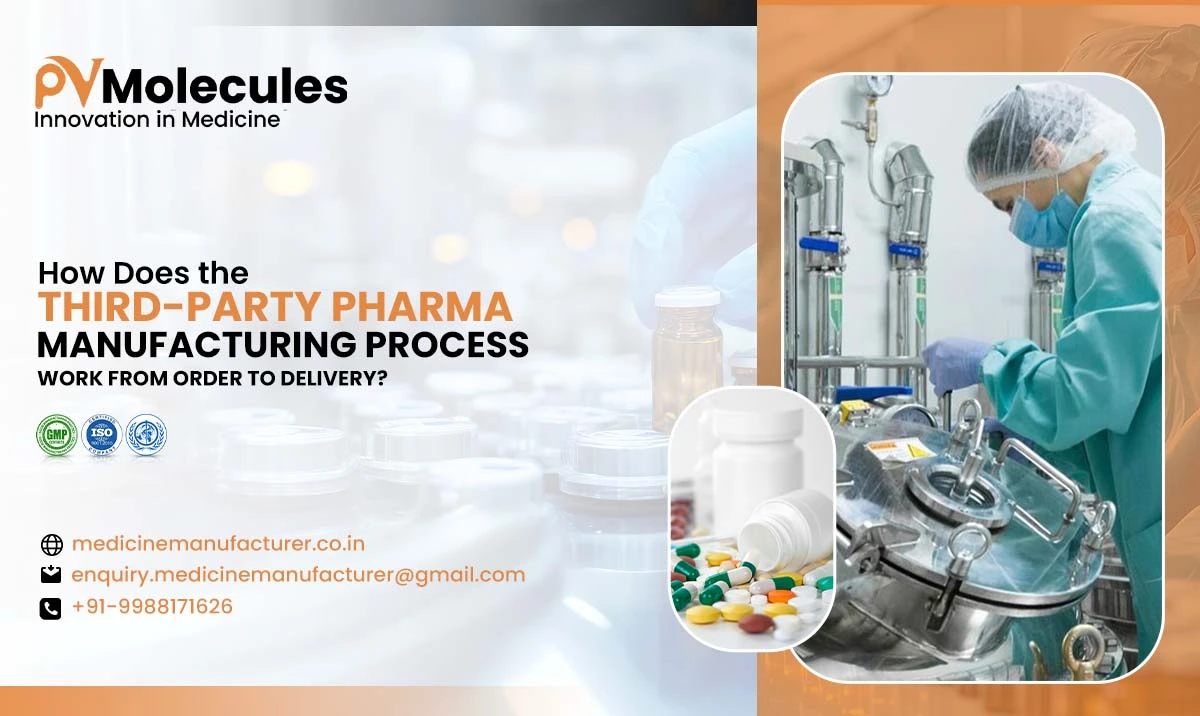
If you are looking to opt for third-party medicine manufacturing services, you must be wondering how it works. Understanding the pharma manufacturing process gives you full clarity and confidence before investing significant capital.
Below is a detailed, step-by-step breakdown of the third-party pharma manufacturing process in India from initial inquiry to final product delivery.
What is Third-Party Medicine Manufacturing?
Third-party pharma manufacturing means one company makes medicines for another company’s brand. The maker owns the plant, the machines and the licence. The brand owner picks the products, designs the packs and handles sales.
Many kinds of businesses use this model. PCD pharma companies, marketing firms, distributors and new start-ups all rely on it. They save the high cost of building a factory. They can spend their time on doctors, chemists and distribution instead. A good manufacturer also brings years of skill in formulas, raw materials and testing. That is hard for a new brand to build alone. Knowing the pharma manufacturing process behind your medicines helps you ask better questions and avoid delays.
How Does the Third-Party Pharma Manufacturing Process in India Work?
The steps below show how a typical order moves from the first call to the delivery of finished goods. The order may vary a little from company to company. But the main steps are similar.
STEP 1: Requirement Sharing
Tell the company which products you need. Add the dosage form, strength and pack size. You are asked to share the order quantity along with target launch data. This is an important step that can shape your experience with the pharma manufacturer.
STEP 2: Product Selection, Samples And Quote
At this stage, the company reviews your brief. They can make suggestions. Many keep a ready product list, so selection is quick. You can also ask for a custom formula. Next, you receive a quote with the price, the minimum order quantity and the lead time.
STEP 3: Agreement and Payment in Advance
Here comes the agreement part. The agreement covers pricing, batch size, payment terms, secrecy and delivery dates. Most makers ask for an advance payment. This books your production slot and pays for materials. Read it with care. It protects both sides if a problem comes up later.
Step 4: Artwork, Labelling and Packaging Approval
Now the design of your cartons, labels and leaflets begins. The company shares a draft with the legal details. These include the composition, batch number, manufacturing date, expiry date and licence number. You add your brand name, logo, MRP and marketing text. Production should not start until you approve the final artwork in writing. Errors on printed packs cost a lot to fix.
Step 5: Raw Material Purchase and Manufacturing
After approval, the plant buys active ingredients, excipients and packing material from checked suppliers. Each item is tested before use. Production then follows a set method for the dosage form. Tablets usually pass through weighing, mixing, granulation, compression and coating. Syrups are dissolved, mixed, filtered and filled. Every batch is written down in a record called the batch manufacturing record.
Step 6: Quality Control and Testing
Quality checks are performed during production and after it. The prepared batch is also passed through other tests to check weight, hardness, fill volume and appearance. The laboratory then tests the finished product for strength, purity and other set limits. Only a batch that passes every test is released. You should receive a certificate of analysis for each batch.
Step 7: Packing and Final Inspection
Approved goods move to the packing line. They are then packed into blisters, strips, bottles or ampoules, followed by going into printed cartons. Every pack has batch numbers and dates. Inspectors check a sample for print quality, count and sealing. The cartons are then placed in shippers and sealed for transport.
Step 8: Dispatch and Delivery
The pharma manufacturer prepares the invoice, the packing list and other transport papers. This includes the e-way bill where it applies. Goods travel by road, rail or air to your warehouse or straight to your distributor. Check the stock on arrival. Report any damage or shortage within the agreed time. Many brands then place repeat orders and add new products.
How to Choose the Right Third-Party Pharma Manufacturing Services
Before you pick a partner for the third-party pharma manufacturing process in India, compare a few options. Keep these points in mind.
- Check the licenses and certificates like WHO-GMP and ISO.
- Verify that they are following Revised Schedule M as well.
- Check their product range.
- Visit the plant, or request a video tour, to see hygiene, equipment and storage.
- Review the quality control laboratory and ask for sample certificates of analysis.
- Compare minimum order quantities, payment terms and lead times, not only the price.
- Confirm that your formulas, brand name and artwork stay protected.
Why Choose PV Molecules for Third-Party Pharma Manufacturing?
We at PV Molecules keep every step of medicine manufacturing transparent and documented.
- We are a certified and accredited company, meaning that we follow international standards of manufacturing.
- We have a wide product range for all therapeutic categories.
- We ensure timely delivery.
- We guide you through every step.
- Call us at +91-9988171626 to start your order.
Frequently Asked Questions
Q1. What is the third-party pharma manufacturing process in India?
Ans: It is the set of steps a licensed maker follows to produce medicines for another brand. The steps cover enquiry, quotation, agreement, artwork approval, production, testing, packing and delivery.
Q2. Who can use third-party medicine manufacturing?
Ans: PCD companies, distributors, marketing firms, hospital groups and new start-ups can all use it. It suits anyone who wants to sell medicines without owning a factory.
Q3. How long does the third-party pharma manufacturing process in India take?
Ans: Many orders take around four to six weeks after artwork approval. The exact time depends on the dosage form, raw material supply and batch size.
Q4. What is the minimum order quantity?
Ans: It is the smallest batch a company will make for one product. It varies by dosage form and by company, so confirm it in the quote.
Q5. Can I request a custom formulation?
Ans: Many makers accept custom formulas. Expect extra time to develop, test and approve them before full production.
Q6. How is quality maintained during manufacturing?
Ans: Quality is checked at every stage. This includes tests on raw materials, checks during production and tests on the finished product. Written records back every batch.
Q7. Who owns the formula and the artwork?
Ans: Ownership depends on the agreement. Write the terms down before work begins, most of all for custom formulas.
Q8 How are finished products delivered?
Ans: Goods travel by road, rail or air to your warehouse or distributor. The company arranges transport or hands the goods to your chosen carrier.
Q9. What documents come with the delivery?
Ans: You usually receive an invoice, a packing list and a certificate of analysis for each batch. An e-way bill is added where it applies.